Judgment with the
power to challenge.
Who can question the evidence, disagree with a recommendation and change the decision?
AI-nterprise · Book & open framework
Ottaviano De Cicco
An AI-nterprise is an organization where people and AI agents work together, with explicit rules for what counts as knowledge, who may judge and act, and how corrections change future work.
Examine one decision · free worksheetWorking together. Learning as an organization.
People · agents · shared workPurpose, judgment
and mandate.
Retrieve, draft
and act within scope.
A basis
for a decision.
Authorized action or revision
An agent can help prepare an assessment, recommend a decision or carry out an action. The organization must decide what that work may be relied on for, who has authority, and how a correction reaches the next case.
Who can question the evidence, disagree with a recommendation and change the decision?
Who granted the mandate, for which purpose, and who can change or revoke it?
Which corrections have been checked, authorized for reuse and shown to affect the next relevant use?
Output is
not knowledge.
Capability is
not authority.
Human presence is not
meaningful human power.
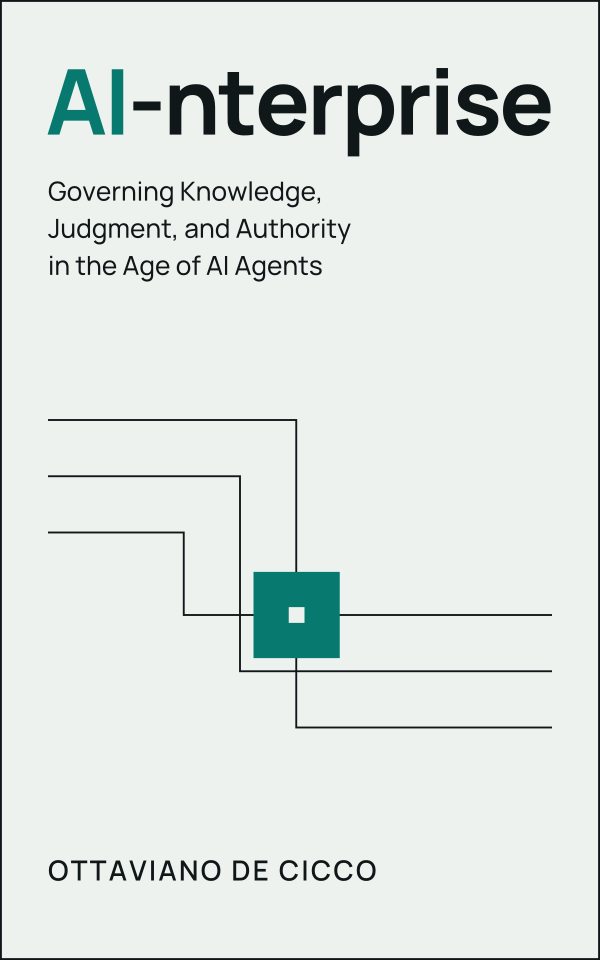
The book · Ottaviano De Cicco
Governing Knowledge, Judgment, and Authority in the Age of AI Agents
AI-nterprise examines how the work of people and AI agents becomes a basis for organizational decisions. It connects knowledge, judgment and authority with practical ways to design a bounded initiative and turn expert correction into reusable learning.
Forthcoming · Q4 2026 · English edition
Explore the bookA claim may come from a person or an agent. Evidence that supports it and a mandate to act are separate conditions. They meet when the claim is used.
Assurance tests the planes and the gate. Its findings go to the responsible owner for correction, separately from the action route.
Four separate decisions
Three control planes
Knowledge and Authority supply distinct conditions at the gate. Assurance independently tests both planes and the gate. Its findings go to the responsible owner for correction.
Three coupled loops
Production creates work and revisions. Assurance challenges and tests. Learning turns verified correction into a change in the next relevant case.
The square's four edge marks represent separate decisions; they are not four green approval lights. This is the book's reference model.
04 / The introduction
People and AI agents contribute to the same work. Follow how that work becomes an organizational decision, and how a verified correction changes the next case.
An illustration of the book's ideas. Explore the visual framework.
The manifesto introduces the argument. The white paper sets out the reference model, its distinctions and limits.

The public argument for governing what humans and agents may know, decide, remember, and do together.
Read the essay
Why corrections and evaluations must become reusable organizational learning.
Read the essay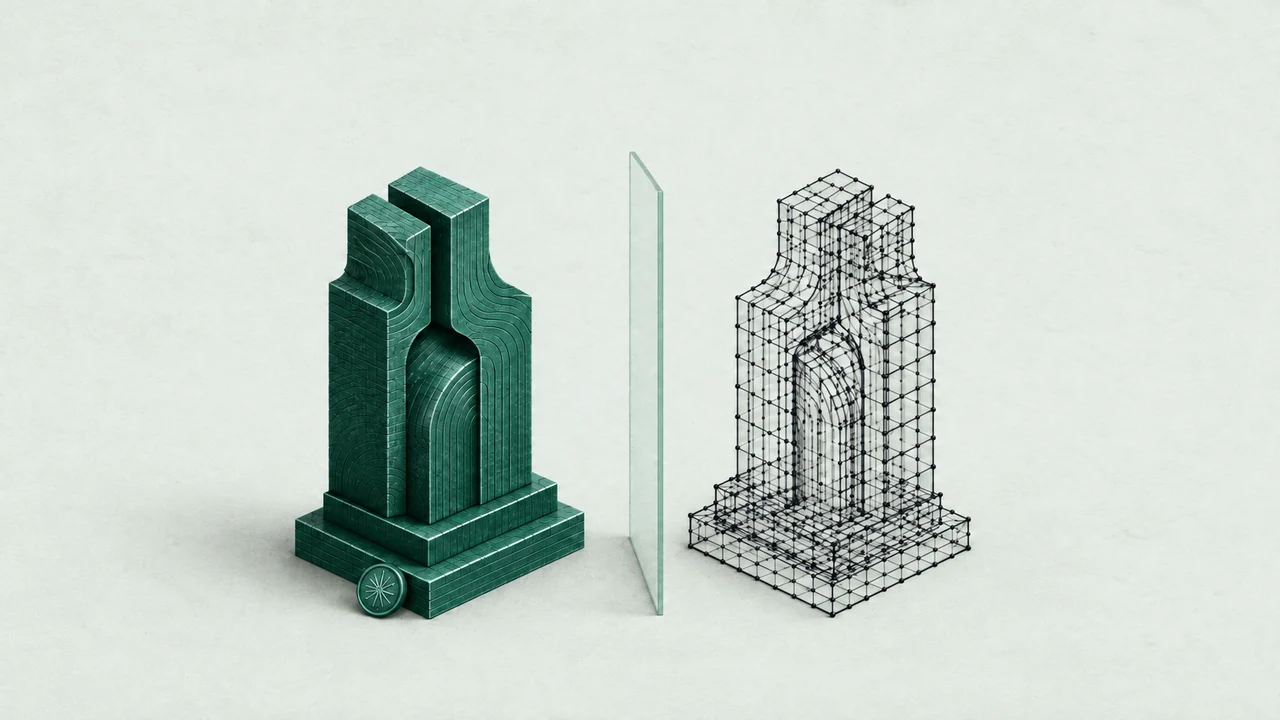
Why judging the human–AI pair matters when fluent output changes a person's confidence.
Read the essay